
About the Journal
The prime purpose of the Journal of the American Pomological Society is to provide a repository for information on all aspects of fruit and nut crops. Originally published as "Fruit Varieties Journal", the Journal of the American Pomological Society is the sole publication of the oldest fruit and nut society in the United States of America, founded in 1848.
Manuscripts reporting original research on a wide range of fruit and nut crops, cultivar releases, rootstocks releases, reviews, and short papers are welcomed. Acceptable areas of research include pruning, nutrition, irrigation, growth regulators, cultural practices, economics, and pest control. Studies involving the interaction of one or more of these aspects with either cultivars and/or rootstocks are particularly appropriate. If in doubt about the suitability of a particular manuscript, please e-mail the Editor at pomologyeditor@outlook.com.
Current Issue
Vol. 80 No. 3 (2026): Journal of the American Pomological Society
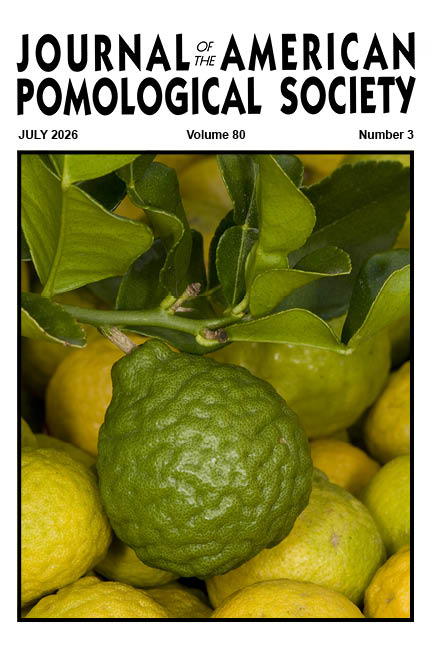
Photo: David Karp
Makrut lime (Citrus hystrix) is a citrus fruit native to Southeast Asia, commonly referred to as Thai lime or, historically, kaffir lime. Many scholars and food writers now avoid the term kaffir because it carries derogatory connotations in certain regions. Wongpornchai (2012) suggests the fruit may have originally been given that name because it was considered smaller or less desirable than other lime varieties. In practice, though, its culinary value and its importance in producing fragrant essential oils far exceed that reputation.
Makrut lime is a staple in Southeast Asian cuisine, valued for the intense citrus aroma that comes from both its fruit and its leaves. Citrus hystrix grows as a small, thorny evergreen tree or shrub, recognizable by its distinctive double leaves. The fruits are compact, round, and covered in a rough, bumpy rind. Because the juice vesicles yield very little liquid—and what they do produce is extremely acidic—the rind, rather than the juice, is the part typically used in cooking. In the United States, the tree is most commonly grown in tropical or consistently warm regions.
Wongpornchai S. 2012. 16 - Kaffir lime leaf. In KV Peter (Ed.), Handbook of Herbs and Spices (Second Edition) (pp. 319–328). Woodhead Publishing. https://doi.org/https://doi.org/10.1533/9780857095688.319.
Published:
2026-07-04
The content on this Journal of the American Pomological Society (the Material) website is copyrighted.