A New Sweet Persimmon: ‘Romang’
DOI:
https://doi.org/10.71318/apom.2018.72.2.74Keywords:
Diospyros kaki, breeding, fruit characteristics, physiological disorderAbstract
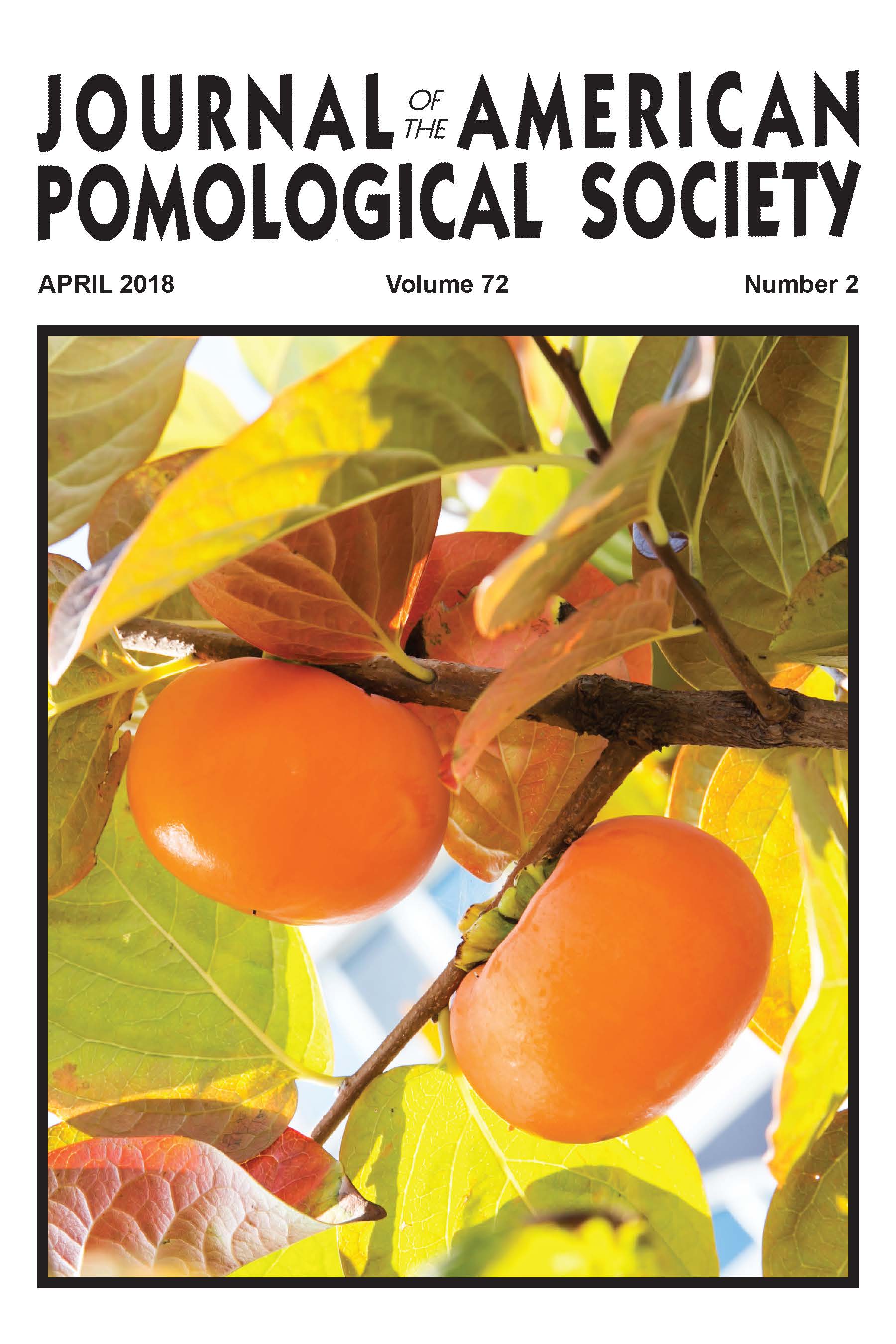
‘Fuyu’ and ‘Jiro’ sweet persimmon were selected and introduced from Japan and account for over 90% of the persimmon production in Korea. The goal of our breeding program is to select domestic sweet persimmon to replace the cultivars from Japan and balance the unequal distribution of late maturing cultivars. ‘Romang’ was a cross of ‘Ro-19’ and ‘Okugosho’ in 1997 and it was selected as ‘97-23-29’ in 2004 for its attractive eating quality and finally selected in 2008 since it had good characteristics with little yearly variation. ‘Romang’ is the first pollination-constant non-astringent (PCNA) persimmon in Korea. The intermediate growth habit is semi-spreading. Its maturation period as a mid-season cultivar was estimated at about 110 days after full bloom. Average fruit weight was 185 g and the fruit has oblate shape, red-orange skin color, and few physiological disorders such as fruit cracking at the apex.
Depending on characteristics of astringency, presence of seeds, and flesh color (Kajiura, 1946; Kikuchi, 1948), persimmon ( Diospyros kaki) cultivars are classified into four types as follows: 1) pollination-constant and nonastringent (PCNA), 2) pollination-variant and non-astringent (PVNA), 3) pollination-variant and astringent (PVA), and 4) pollination-constant and astringent (PCA). The PCNA type is qualitatively different from the other three types in the level of tannin accumulation in the fruit because the PCNA-type fruit accumulates less tannin and the tannin cells are much smaller than in the other three types (Yonemori and Matsushima, 1985; Kanzaki et al., 2001). Persimmon is one of the major fruit crops and among the oldest cultivated fruits in Korea. Most cultivars are astringent, and the PVNA cultivar ‘Johongsi’ is generally known and appeared in Daeduck area of Damyang county, Jeon-nam province. In Korea, all of the sweet persimmons cultivated commercially were introduced from Japan in the 1900s. All nonastringent cultivars are of Japanese origin, except for ‘Luo Tian Tian Shi’, which is of Chinese origin (Yamada et al., 1993; Yamada et al., 1994; Wang, 1982). In 2014, persimmon production was 385,000 T and ranked second behind China, and is cultivated on 27,000 ha in Korea (Korea Statistical Information Service, 2016). Sweet persimmon’s area has dramatically decreased from 20,000 ha in 2000 to 11,800 ha in 2015 (Korea Statistical Information Service, 2016). The main reason for declining production likely is the unequal distribution of cultivars ‘Fuyu’ and ‘Jiro’ which have poor fruit quality and ripen late, and are susceptible too cold injury in the fall. Therefore, we need to develop new cultivars that have good fruit quality and ripen earlier than ‘Fuyu’ and ‘Jiro’. The PCNA genotype appears to be homozygous recessive for the natural loss of astringency, since the trait of natural astringency-loss in PCNA-type fruit is qualitatively inherited in the progenies and the PCNA genotype is recessive to the other three types (Ikeda et al., 1985; Kanzaki et al., 2001). Therefore PCNA-type cultivars are usually used to obtain PCNA-type seedings. We aim to develop persimmon cultivars of PCNA-type that are earlier maturing and have less physiological disorders than those introduced from Japan. In this study, we selected a new sweet persimmon cultivar that matures 15 days earlier and has less physiological disorders than ‘Fuyu’, and fruits had high sugar concentrations and soft juicy flesh.
Downloads
Published
License

This work is licensed under a Creative Commons Attribution-NonCommercial 4.0 International License.
The American Pomological Society and Editors cannot be held responsible for the views and opinions expressed by individual authors of articles published herein. This also applies to any supplemental materials residing on this website that are linked to these articles. The publication of advertisements does not constitute any endorsement of products by the American Pomological Society or Editors.