
Rutgers Cranberry Breeding Program
DOI:
https://doi.org/10.71318/apom.2022.76.1.2Keywords:
cranberry breeding, genetics, disease resistance, molecular markers, mapping, QTLsAbstract
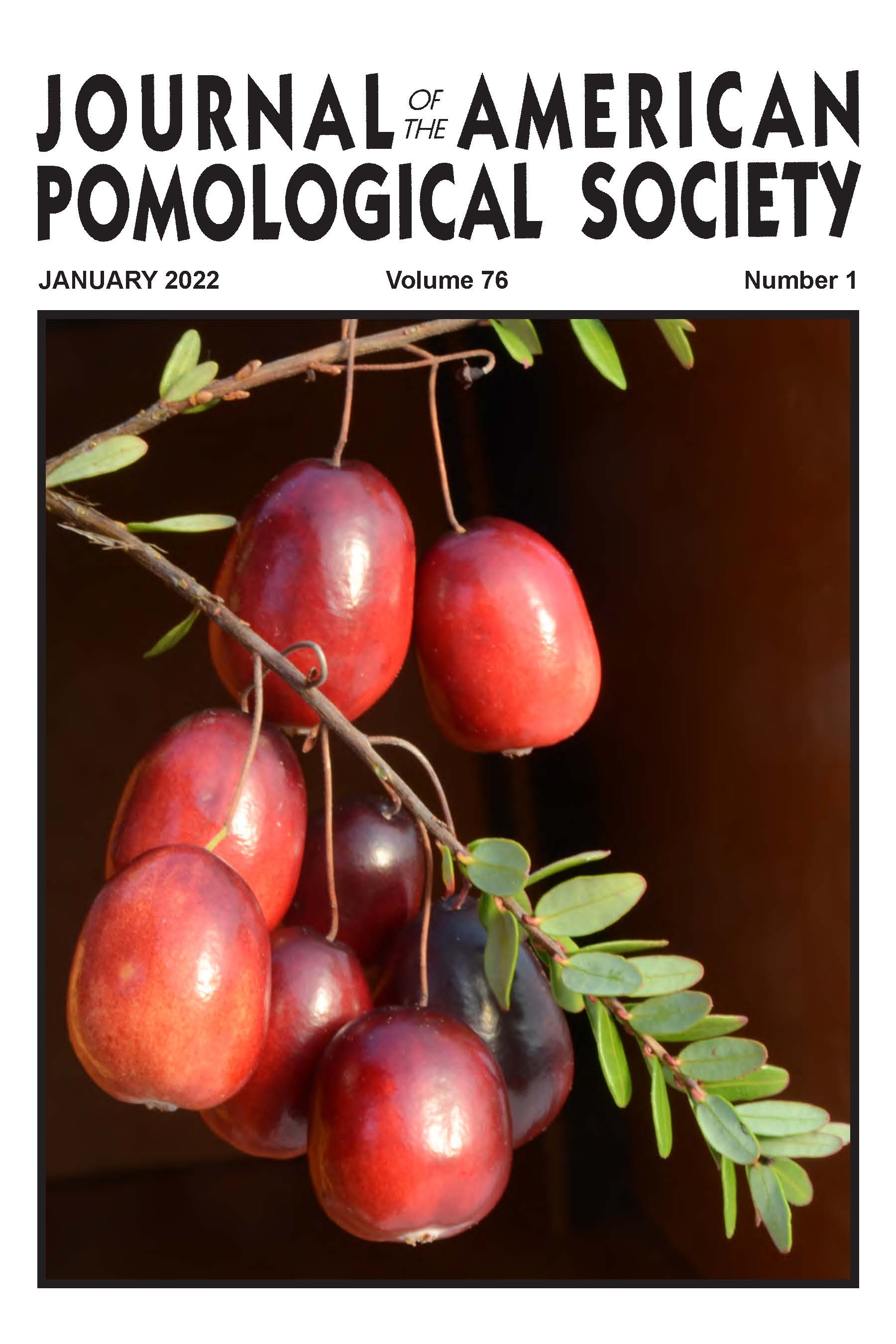
The American cranberry ( Vaccinium macrocarponAiton) is an American fruit species native to northeastern US and southeastern Canada. The United States is a leader in cranberry production. Domesticated less than 200 years ago, breeding efforts did not start until 1929. The American cranberry is a long-lived woody perennial adapted to a temperate climate and well drained moist acidic soils. Cranberry reproduces both sexually and asexually, through stolons, which are used for clonal asexual propagation of cultivars. The flower is hermaphroditic, which needs to be pollinated, usually by hymenoptera pollinators for fruit set. Traits of economic importance include productivity, propagation vigor, disease resistance, fruit anthocyanins, brix, and increasingly fruit quality traits for sweetened-dried-cranberry products, e.g., fruit firmness and fruit size. Rutgers/NJAES has patented and released seven cultivars from a second breeding and selection cycle. The cultivars ‘Crimson Queen’ and ‘Demoranville’, selected and released for the juice market, were released for early season, high fruit color and improved productivity. ‘Mullica Queen’ is a mid-season cultivar with exceptional productivity. The cultivar ‘Welker’ is highly productive with precocious fruit bearing but is more predisposed to fruit rot, thus is recommended for growing regions with little to no fruit rot pressure, e.g, as in the oceanic climate of the Pacific Northwest. The ‘Haines’ cultivar is noted for high productivity, uniform color, firmness and has exhibited less fruit rot in variety trials than standard varieties, e.g., ‘Stevens’. ‘Vasanna’, a full-sibling of ‘Haines’, has performed exceptionally well in 100 per cent peat soils of British Columbia. Quantitative trait loci (QTL) have been identified for productivity, berry size, total fruit anthocyanins measured as mg per 100 grams of fruit, fruit rot resistance and other traits. The fruit of American cranberry is recognized for human health benefits to due to very high levels of the flavonoid classes, anthocyanins, proanthocyanidins, and flavonols, which result in a very high anti-oxidant status. Recent restrictions of traditional pesticides to control insect and disease pests have altered the ecology with former challenges, e.g., false-blossom, having a re-emergence. Genetic improvement of cranberry has been hampered by a long generation interval including three years from pollination to flower, and assessment of yield requiring 6-8 years after field planting, with typically limited field acreage for breeding.
Downloads
Published
License

This work is licensed under a Creative Commons Attribution-NonCommercial 4.0 International License.
The American Pomological Society and Editors cannot be held responsible for the views and opinions expressed by individual authors of articles published herein. This also applies to any supplemental materials residing on this website that are linked to these articles. The publication of advertisements does not constitute any endorsement of products by the American Pomological Society or Editors.